







Bananzia Casino
Bananzia is an online casino brand running reels, dealt tables, live rooms, instant formats and a sportsbook from one account. The question of when a brand began looks like trivia and is in fact the single most predictive fact about it, because the features an operator can offer divide cleanly into the ones available on the first day and the ones that can only be built over years. Knowing which is which explains almost everything a newer brand does differently, including why its opening offers are shaped the way they are.
Five traits that follow from a brand's age
The division is consistent across the sector, and for Bananzia as for anyone it reduces to five things an operator either buys or earns.
| Trait | Available on day one | Takes years to build |
|---|---|---|
| Catalogue | bought whole through an aggregator | nothing, it arrives complete |
| Live floor | licensed from a studio immediately | nothing, the tables are shared |
| Loyalty ladder | can be published at launch | the data to set its thresholds sensibly |
| Native applications | not until a store approves | a listing in each territory |
| Local payment routes | the common international ones | per-market processor agreements |
Read across the table and the pattern is clear. Everything a player sees inside the games arrives complete, and everything around the games has to be assembled.
Which is why a new Bananzia-era brand can look identical to a decade-old one in its catalogue and behave quite differently at the cashier. The games were bought; the payment routes were negotiated.
It also explains why catalogue size is a poor way to judge any operator. A brand three months old can carry several thousand titles from the same studios as a brand ten years old, because both bought from the same supply.
The Bananzia crypto welcome bonus and why it leads
Newer operators lead with coin-funded offers far more often than established ones, and there are three structural reasons rather than a marketing preference.
The first is cost. A coin transfer's network fee is paid by the sender, so a small coin deposit costs the operator nothing to accept, which makes a percentage attached to it cheaper to fund than the same percentage on a card.
The second is reach. A coin route works in every market at once without a processor agreement, which matters most to a brand that does not yet have local routes in many of them.
The third is settlement. A coin payout clears in minutes rather than days, which turns payout speed into something a Bananzia crypto welcome bonus can genuinely promise rather than merely hope for.
What a coin-funded offer asks in return
The clauses on a coin-funded Bananzia offer are the same four as on any other, and one behaves differently because of the balance it sits in.
The multiple, the contribution rate, the maximum stake and the conversion ceiling all apply unchanged. What changes is that a balance denominated in a floating coin moves in value while a condition is being cleared.
A coin balance that falls eight per cent across a clearing week has reduced the real value of whatever converts by eight per cent, regardless of how the play went, and a balance that rises has done the reverse. No term mentions it because it is nobody's decision.
The matching conclusion is practical. A condition cleared over days sits more comfortably in a stable denomination, and a deposit played and withdrawn inside a session can use any route without the question arising.
The Bananzia casino welcome pack across deposits
Where a Bananzia opening package spans more than one deposit, the figure that describes it is not the headline total but the sequence underneath.
Three numbers do that work: what each step pays as a percentage, what ceiling each step carries, and what deposit fills each ceiling exactly. A step paying a high percentage with a low ceiling is filled by a small deposit; a step paying less with a high ceiling needs a large one.
Totalling the deposits required to fill every step gives the real size of a Bananzia casino welcome pack, and it is almost always a larger figure than people expect from the advertised total.
Against that, the headline is the least informative number in the offer. It describes the credit available and says nothing about what reaching it costs.
What a loyalty ladder needs before it works
A Bananzia loyalty scheme, like any other, can be published on launch day and cannot be calibrated on launch day, and the difference shows.
Thresholds have to be set against how much accounts actually stake, which is information an operator only has after a year or two of records. A ladder published too early tends to have levels nobody reaches or levels everybody reaches in a week.
Which is why newer brands often run simpler schemes: a flat cashback percentage, or points at a single rate, rather than a long tier structure with graded benefits. A simple scheme is the honest version of a young one.
The figures to look for in any scheme are the same two regardless: the earn rate per unit of turnover and the redemption rate. Multiplied together they give the rebate as a percentage, which is the only comparable number a Bananzia bonuses structure produces.
A catalogue bought whole
Reel and table titles reach Bananzia through an aggregator holding the integrations, which means a catalogue is a purchasing decision rather than a development project.

The consequence is that a new brand's shelves are indistinguishable from an established one's. The same studios, the same titles, the same configured returns, because those figures belong to the studios and travel with the games.
What a young catalogue does sometimes lack is depth in the long tail. An operator that has signed the large suppliers first will have whole libraries at the top and fewer of the small specialist studios, and that is a purchasing sequence rather than a quality difference.
For a Bananzia account the practical reading is that the games are the part of a brand least affected by its age, and the part most often used to judge it.
Bananzia live casino from the first day
Dealt tables are licensed rather than built, which is why the Bananzia live floor was available immediately and looks the same at every age of operator.
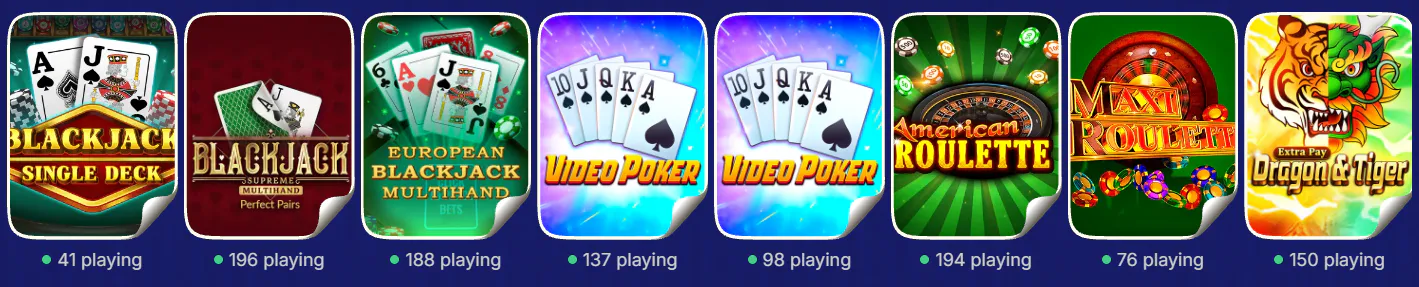
The studio employs the dealer, sets the seats, the round length, the stake bands and the variants. Which tables appear is the operator's choice, and a band can be narrowed, but the length of a round is not something it can alter.
For a Bananzia live casino session the practical consequence is that the bands are the choice. Moving up a band multiplies hourly exposure at identical mathematics, which is the one change on a live floor that feels like nothing.
Bananzia games: the part that is never new
Underneath the themes, the Bananzia catalogue runs on the same small set of engines any catalogue does, and recognising them says more than a release date.
Fixed paylines, cluster and ways engines, variable-reel engines, hold-and-win grids and accumulating-multiplier features cover nearly all of it. A title released this month and one released a decade ago may share an engine exactly.
Each title publishes three figures with itself: the configured return, the volatility rating and the maximum multiplier. Those travel with the game, which is why reading them is the one assessment of Bananzia games that does not depend on who is carrying it.
Bananzia sportsbook as a second product
A sportsbook is the other thing a young brand can have immediately, because Bananzia pricing and market feeds are bought in the same way a catalogue is.
What differs from the casino is the clock. A casino round settles inside the session that placed it, while a bet settles on its event hours or days later, which makes the Bananzia sportsbook the only part of an account that resolves while nobody is watching.
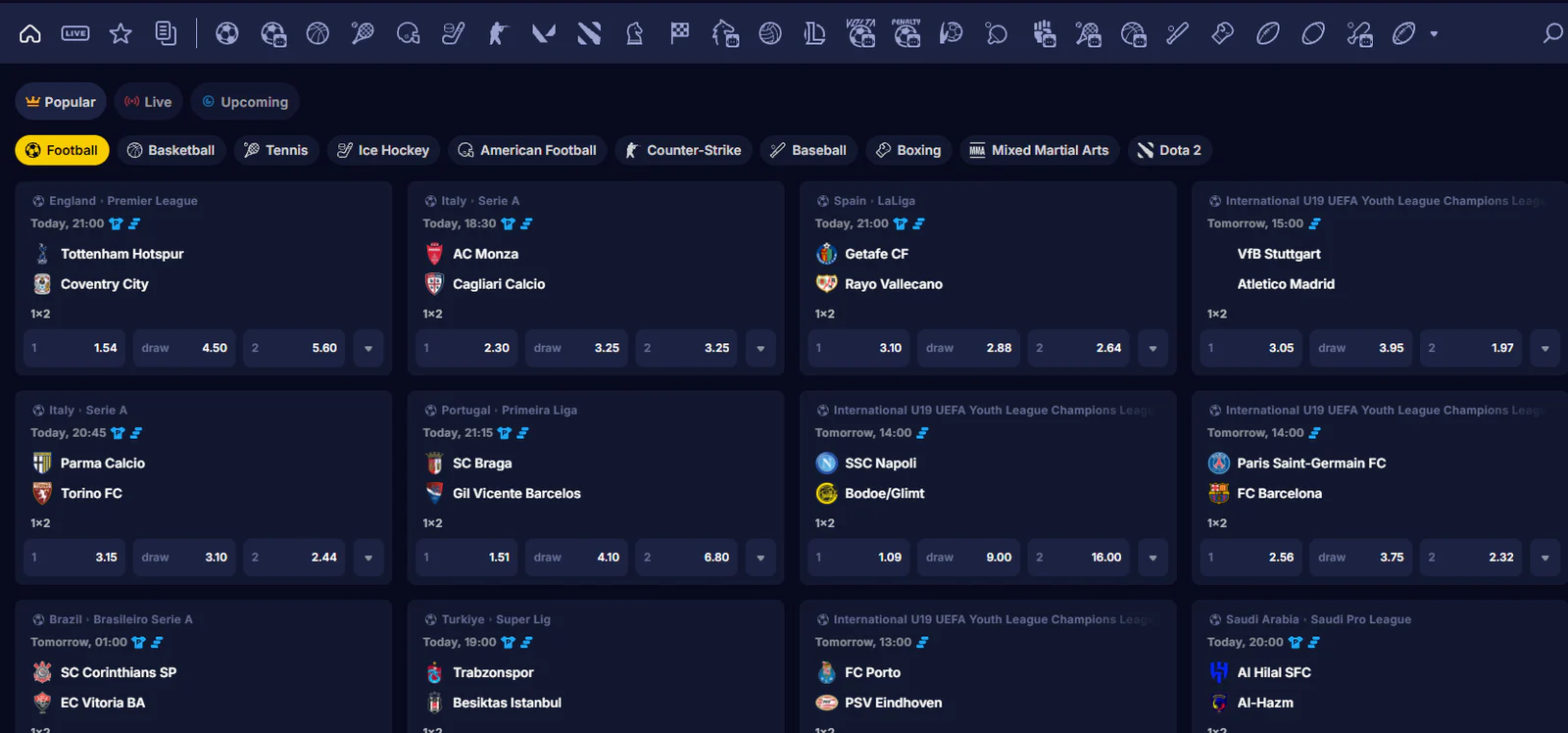
Offers divide along the same line. Casino conditions are usually expressed as a multiple of a credited amount; sports offers more often arrive as free bets with their own separate rules about stake return and minimum prices.
One rule follows from the single balance behind both. Where an offer specifies a product, a stake on the other side still leaves the same pot and may contribute nothing towards the condition attached.
Local payment routes as the slowest build
Payment routes are where a brand's age is most visible to anyone looking at Bananzia or at any competitor, and the reason is that each one is a separate commercial agreement.
International cards, international wallets and coin networks are available quickly, because they are global products. A domestic instant-transfer scheme, a national voucher or a local bank integration each needs its own processor relationship in its own market.

So a Bananzia payment methods list heavy on international routes and light on local ones is the signature of a young operator rather than a judgement about it. The list grows market by market as agreements are signed.
The practical point for an account is unchanged by any of it. A payout normally returns the way a deposit arrived, so the route chosen at the first deposit sets the speed of the first withdrawal whichever list it was chosen from.
A Bananzia login and the account behind it
A Bananzia account holds money, identity documents and a payment route, which is why entry is built in three layers rather than on a password.
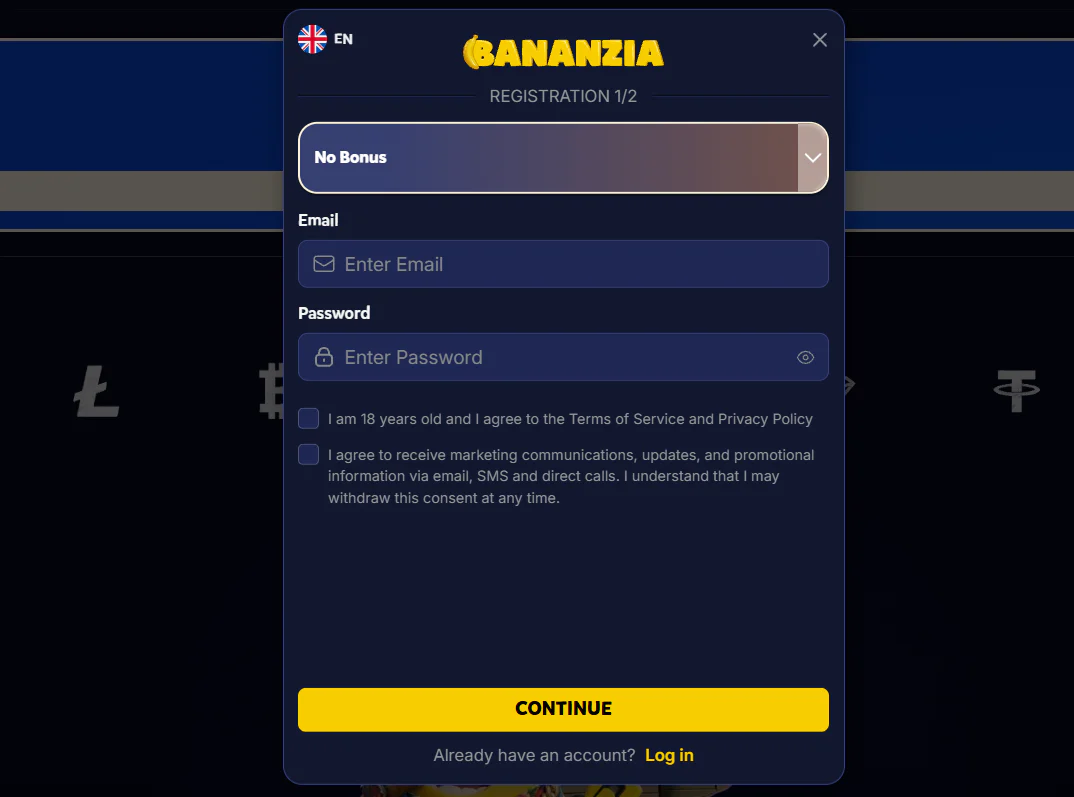
The password is the first, a one-time code the second and the verification file already on record the third, since a payout can only reach an instrument in the verified name.
That third layer is why one verified person holds one account, and it is a licensing requirement rather than a brand preference, which means it applies at every age of operator equally.
Controls that do not depend on a launch date
Five controls sit inside a Bananzia account and all five are regulatory rather than optional: deposit limits, loss limits, session reminders, time-outs and self-exclusion.
A reduction applies at once while an increase waits out a stated period. That asymmetry is the same at a brand three months old and one twenty years old, because it is written into the conditions a licence imposes.
For players in the United Kingdom, GamCare operates the National Gambling Helpline on 0808 8020 133, free and in confidence at any hour, and BeGambleAware sets out written material and local services. An account can be opened only by an adult of eighteen or over.
How to read a launch year without guessing
Nothing above requires an opinion about whether a newer brand is preferable, and the useful reading of a launch year is a checklist rather than a verdict.
Four questions settle it. Does the catalogue name identifiable studios, since that is bought and therefore says nothing about age. Does the route list include anything local to the market, since that is negotiated. Is there a native application in this territory, since that waits on a store. And is the loyalty scheme a flat rate or a long ladder, since calibration needs records.
Answered together, those four describe where a Bananzia-era operator sits on the curve far more accurately than a date does, and every one of them can be checked from outside an account.
The fifth question is the one that matters most and has nothing to do with age at all: whether the terms are published in full with figures rather than ranges, and whether a complaint path with a named independent body appears in them.
Why a native application takes longest
An application is the Bananzia feature most constrained by something outside an operator's control, because a platform store decides whether real-money gaming may be listed in a given market.
That approval is granted territory by territory, which means a young brand frequently has no native build anywhere and an older one has builds in some markets and not others. Neither says anything about the brand's capability.
The substitute is an installed web application, which saves the site to a phone and behaves much like a native one without needing approval. It reaches the same account, the same catalogue and the same cashier, because all three belong to the account rather than to the route in.
Nothing in a Bananzia cashier changes with the route either. Floors, bands, ceilings and verification are properties of the account, so a phone session meets identical figures to any other.
Bananzia casino players and a young account base
One effect of the Bananzia launch date falls on players rather than on the operator, and it is worth stating because it is easy to misread.
Networked jackpots grow from stakes placed across every operator carrying them, so the size of a pool has nothing to do with how many Bananzia casino players are staking on it. A new brand's jackpot figures are the network's figures.
Live tables work the same way. A named table is one broadcast serving many operators, so its seats fill from the whole room rather than from a single brand's traffic, and availability at a busy hour is a property of the network.
What a young account base does affect is the loyalty calibration described earlier, and nothing else a player meets directly.
Figures that only the source has
Several figures above belong to the published material rather than to an article: the launch year the brand states for itself, the current route list and its floors, the conditions on any live campaign, and the earn and redemption rates of whatever scheme exists.
The structure does not move with them. A catalogue and a live floor are bought and arrive complete, a loyalty ladder needs data before it works, an application waits on a store, and local payment routes arrive one market at a time.